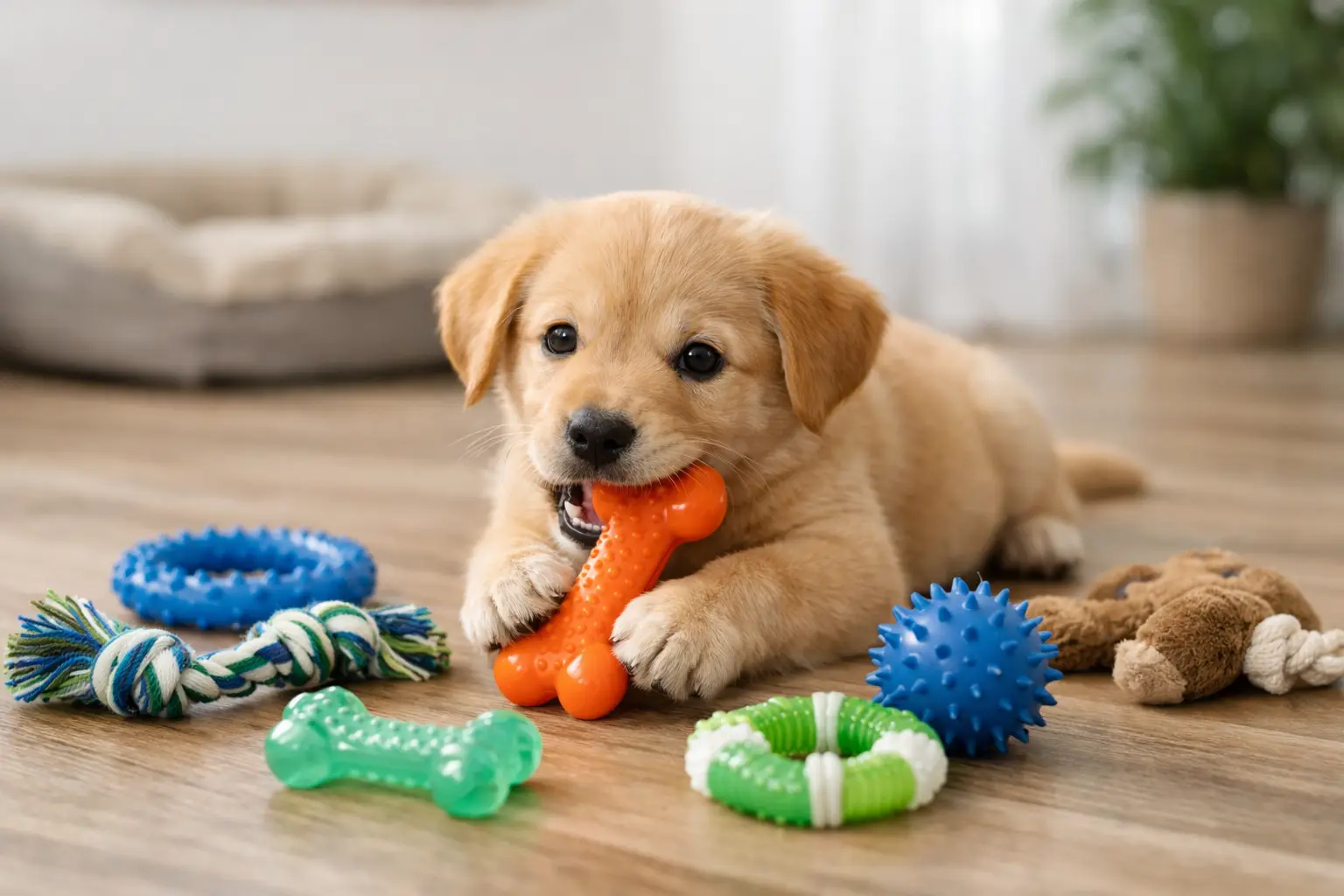
If your puppy has suddenly decided that chair legs, shoelaces, and your hands all count as chew toys, teething is probably in full swing. The best puppy teething toys help redirect that urge into something safer, gentler on sore gums, and a lot easier to live with while your pup grows through the chewing phase.
A good teething toy does more than give your puppy something to bite. It should feel satisfying to chew, be sized appropriately for your dog, and hold up without being so hard that it risks hurting developing teeth. For most puppies, the sweet spot is a toy with some give – firm enough to last, but not brick-hard.
Material matters quite a bit here. Soft rubber, puppy-grade nylon, fleece, rope blends, and freezable fabric toys are all common choices. Each one suits a slightly different chewing style. A gentle nibbler may love a plush teething toy with textured edges, while a determined chewer often needs a sturdier rubber option with grooves or ridges.
It also helps when the toy does more than one job. Texture can massage gums. A hollow center can hold treats. A shape that bounces or rolls can turn chewing into play. For busy pet parents, that kind of versatility is a win.
These are a classic for a reason. A soft rubber ring is easy for small mouths to grab, and the rounded shape lets puppies chew from different angles. Look for flexible rubber with ridges or nubs that can gently massage sore gums.
This style works especially well for younger puppies that are still figuring out how to chew without getting frustrated. It is usually one of the safest starting points.
A chilled toy can feel amazing on tender gums. Freezable options are often made with fabric, gel-lined interiors, or soft rubber designed to cool down without becoming rock hard.
The trade-off is durability. These toys are great for comfort but may not last as long with heavy chewers. They are best used during supervised play, especially if your puppy is good at tearing seams.
Rubber bones designed specifically for puppies are a reliable everyday option. They usually have a little more structure than rings, which can make them more satisfying for pups that want to really work their jaws.
Choose a version labeled for puppy use rather than adult power chewers. That distinction matters because a toy that is too hard can be a poor match for young teeth.
Some puppies need a little motivation to stick with a toy instead of your furniture. A treat-dispensing toy adds that reward while keeping them occupied longer.
This can be especially helpful during crate time or when you need to keep your puppy busy for a few minutes. Just keep portions in mind so snack time does not quietly turn into overfeeding.
Chew sticks with grooves, bumps, or bristle-like ridges can be a smart pick for teething pups. The texture gives them something interesting to work on, and many puppies seem to prefer toys that do not feel completely smooth.
These are handy for puppies that get bored quickly. The extra texture can keep them engaged longer than a plain toy.
A soft rope toy can be a good option for puppies who like to gnaw and tug but are not intense shredders. The fibers give a different chewing experience, and many pups enjoy switching between chewing and carrying the toy around.
That said, rope is not the best fit for every dog. If your puppy tears off strands and tries to swallow them, skip this category and stick with safer rubber alternatives.
Some puppies want comfort as much as chewing relief. Plush teething toys can be a nice match for cuddly pups, especially when they include crinkly sections, knotted corners, or built-in textured panels.
These are usually not long-haul chew toys. Think of them as a softer option for puppies who want variety, not as the one toy that has to survive everything.
These toys are made to be easy to grip and mouth, which makes them great for very young puppies. The shape is simple, and many designs include multiple textures across the surface.
They are often a smart first teething toy because they are approachable. Puppies do not have to work very hard to understand how to use them.
Silicone can be softer than some rubber toys, so it can work well for puppies with especially tender mouths. A silicone toy with raised texture is often a nice comfort choice during the peak teething stage.
The downside is that not all silicone toys are equally durable. If your puppy is an enthusiastic chewer, inspect them often and replace them as soon as they start to break down.
A chew ball gives your puppy something to mouth, chase, and bat around. Many have open designs or textured surfaces that make them easy to pick up and fun to chew.
This is a strong choice for energetic pups that need help burning off some extra energy. When a toy supports both play and teething relief, it tends to get more use.
Edible puppy chews are not toys in the usual sense, but they definitely belong in the conversation. They can provide relief and keep your puppy busy, especially during rough teething days.
Just make sure the chew is age-appropriate and made for puppies. Supervision matters here too, since edible chews vary a lot in texture, size, and how quickly they soften.
If you are not sure what your puppy likes yet, a small variety set can be the easiest way to find out. One pup may ignore the plush toy and obsess over the rubber bone. Another may only care about the treat toy.
For many pet parents, variety is the most practical route. It saves you from guessing, and it helps keep playtime fresh while your puppy’s preferences change.
The best choice depends on your puppy’s age, breed size, and chewing style. A tiny puppy may need a lightweight toy that is easy to carry, while a larger breed puppy may outgrow that same toy almost immediately. Size matters because toys that are too small can become a choking risk, and toys that are too big may not get used at all.
Chewing intensity matters just as much. Some puppies are casual nibblers. Others seem determined to test every material in the house. If your puppy destroys soft toys in minutes, skip plush-heavy picks and lean toward puppy-grade rubber or sturdier textured chews.
It is also smart to think about when the toy will be used. For active daytime play, a chew ball or rubber ring makes sense. For calming downtime, a freezable toy or a soft comfort chew might be the better fit. A small mix of toy types usually works better than expecting one toy to do everything.
Even the best puppy teething toys need regular checks. If a toy starts cracking, shedding pieces, or becoming small enough to swallow, it is time to replace it. Puppies are surprisingly talented at turning a worn toy into a problem.
Avoid toys that are too hard. A simple rule many pet parents use is this: if it feels as hard as a rock or you would not want it tapped against your own teeth, it is probably not ideal for a teething puppy. Younger mouths need relief, not extra stress.
Supervised play is always the safest approach with new toys. Once you know how your puppy chews and what they tend to do with a toy, you can make a better call on whether it is suitable for solo time.
Teething toys are helpful, but they are not magic. Puppies also need naps, routine, and redirection. A tired, overstimulated puppy often chews more wildly than one that has had enough rest and play.
If your puppy is chewing everything nonstop, rotate toys instead of leaving the same one out all day. Novelty helps. So does calmly redirecting them every time they go for something off-limits. It takes repetition, but the habit does start to stick.
For pet parents who want easy, pet-approved options in one place, stores with a wide mix of chew toys, comfort items, and daily essentials make the process simpler. That is part of the appeal of shopping at Doggodays.shop – you can compare different puppy teething toy styles without turning it into a full scavenger hunt.
A teething puppy can be a little chaotic, but the right toy selection makes daily life a lot easier. Start with safe, size-appropriate options, pay attention to what your puppy actually enjoys, and let their chewing style guide your next pick.








Leave a comment