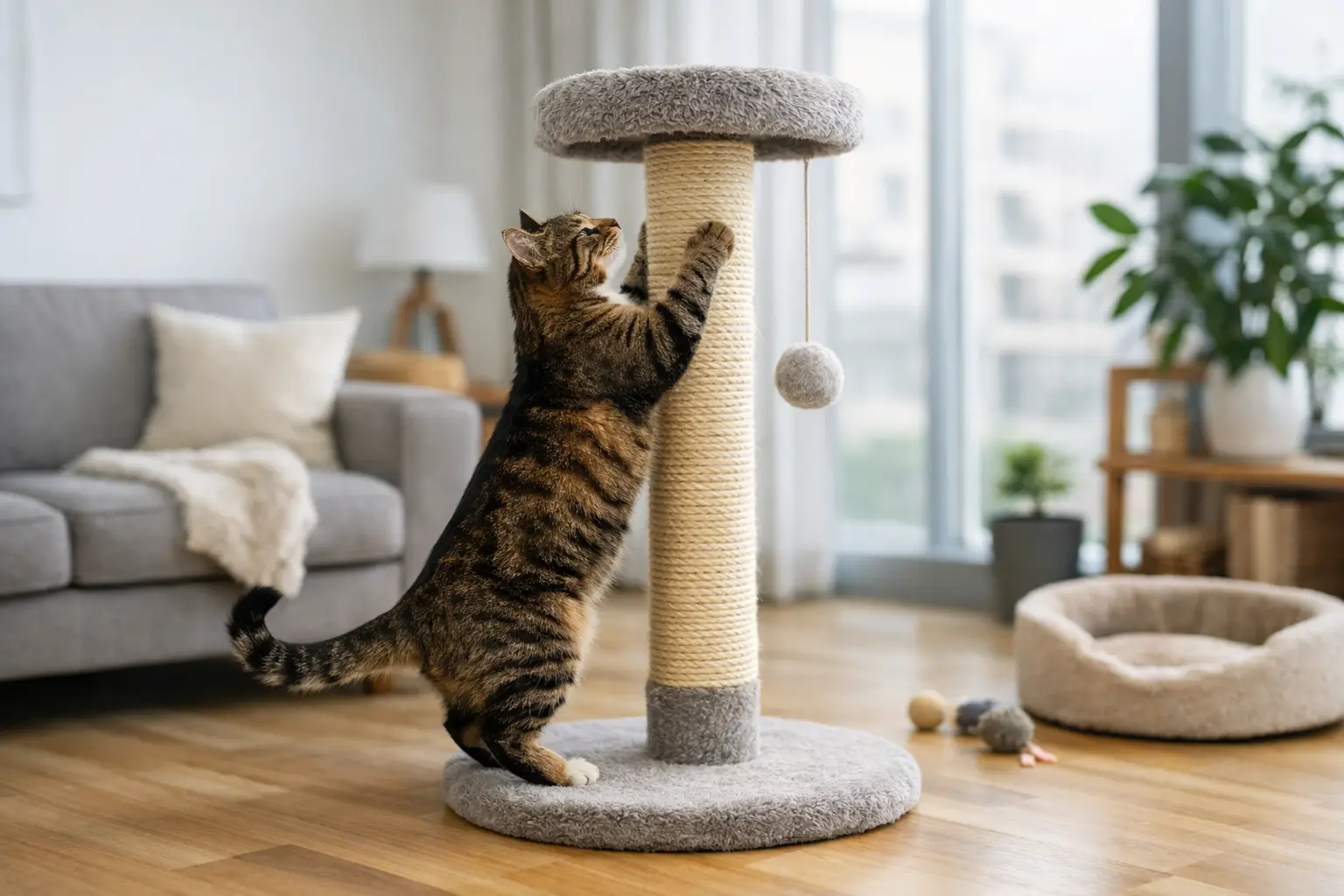
That corner of the couch your cat keeps working on is usually a pretty clear message – the current setup is not winning. Finding the best cat scratching post for apartment living is less about buying the biggest tower and more about picking something your cat will actually use without taking over your floor space.
Apartment homes come with a few real limits. You may have less room, thinner walls, nearby neighbors, and furniture doing double duty in smaller spaces. A scratching post has to fit that reality. It needs to satisfy your cat’s instinct to scratch, stretch, and mark territory while also being sturdy, compact, and easy to live with every day.
The short answer is balance. In a larger house, you can get away with oversized cat trees, multiple scratching stations, and a trial-and-error approach. In an apartment, every item has to earn its spot.
A good apartment-friendly scratching post should be tall enough for a full stretch, stable enough that it does not wobble, and slim enough to fit naturally into your living space. Most adult cats want to scratch vertically with their front legs extended, so a short post often gets ignored. If your cat reaches up and the post feels cramped, the sofa arm starts looking better.
Stability matters just as much as height. A lightweight post that tips after one energetic scratch can make some cats avoid it altogether. Others will still use it, but now you have noise, movement, and irritation on hard apartment floors. A wider base or heavier construction usually solves that.
Material also plays a big role. Sisal is the most common favorite because it gives cats resistance without shredding too quickly. Carpet-covered posts can work for some cats, but they may blur the line between what is okay to scratch and what is not, especially if your home already has rugs or upholstered furniture with a similar feel. Cardboard scratchers are popular too, though they are often better as a supplement than a main post if your cat prefers upright scratching.
Many shoppers start with dimensions, which makes sense, but placement is where a lot of apartment cat setups succeed or fail. Even the best scratching post can be ignored if it is tucked in a back room your cat never uses.
Cats usually want to scratch in high-traffic areas, near sleeping spots, or close to the furniture they already target. That does not mean your living room has to look like a pet store aisle. It just means the post should live where scratching naturally happens. A narrow vertical post beside the couch, a corner scratcher near the entryway, or a compact scratching tower near a sunny window often works better than a larger piece hidden away.
If space is tight, look for designs with a small footprint and useful vertical height. A post that rises up instead of spreading out across the floor is often the smartest choice for apartment layouts. Some cat parents also do well with corner-friendly scratchers because they use awkward dead space instead of blocking walkways.
This depends on your cat more than the product category.
A classic vertical scratching post is usually the best all-around choice for apartment living. It is easier to place, usually more affordable, and works well for cats that love a full-body stretch. If you are only buying one scratcher, this is often the safest first pick.
A horizontal cardboard lounger can be a great add-on for cats who like to scratch low to the ground, lounge between play sessions, or quietly shred something after meals. It is also easy to slide under a console table or place near a window. The trade-off is mess. Cardboard bits collect fast, which is not ideal if you are trying to keep a small apartment tidy.
A full cat tree with scratching sections can be the right fit if your apartment lacks climbing opportunities and your cat is very active. The upside is that one piece can cover scratching, perching, and resting in one footprint. The downside is visual bulk. In a studio or smaller one-bedroom, a large tree can dominate the room unless you choose a slimmer design.
When comparing options, focus on the details that affect real daily use. Height is first. For most cats, a post around 30 inches or taller gives a more satisfying stretch than shorter models. Larger cats may want even more room.
Next is base weight. A post with a broad, heavy base tends to feel secure and stay quieter on wood or tile floors. If your apartment has downstairs neighbors, this matters. Less wobble usually means less thumping.
Sisal quality is another thing worth checking. Tightly wrapped sisal rope tends to hold up better than loose wrapping that unravels quickly. If your cat is an enthusiastic scratcher, durability matters because replacing a post too often gets expensive and inconvenient.
A replaceable or reversible scratching surface can also be helpful, especially in smaller homes where you do not want to keep swapping out bulky pet furniture. Some apartment-friendly scratchers are designed to last longer simply because the worn part can be refreshed instead of replacing the whole piece.
Looks count too. In an apartment, your cat’s furniture is often your furniture. Neutral colors, simple shapes, and cleaner finishes usually blend in more easily with your space, which makes it more likely the scratching post stays out where your cat will use it.
There is no single best cat scratching post for apartment setups if your cat hates the material or shape. Your cat’s current behavior gives you the best clues.
If your cat scratches couch arms or dining chair legs, a vertical sisal post is probably the strongest match. If your cat goes for rugs or mats, a horizontal scratcher may feel more natural. If your cat likes to climb curtains, bookshelves, or window ledges, a taller scratching tower with a perch may be worth the extra space.
Multi-cat apartments need a little more strategy. Shared territory can create competition, and one scratching post may not be enough. In that case, it is often better to use two smaller scratchers in different spots rather than one large piece in a single room. That setup helps reduce crowding and gives each cat a place to mark and stretch.
Kittens usually do fine with a smaller post at first, but buying too tiny can backfire if they outgrow it quickly. Adult cats, especially larger breeds, need something more substantial from the start.
Buying the right post is only half the job. Introduction matters.
Set the scratching post near the spot your cat already likes to scratch. That feels obvious, but many people place the new post where they want it rather than where the cat wants it. If the couch corner is the current favorite, start there. Once the habit is built, you can sometimes move the post a short distance.
You can also encourage use with catnip, toys, or gentle praise when your cat scratches the right surface. What usually works best is making the good option easy and the bad option less appealing. A couch protector, a throw blanket over the target area, or a little rearranging can help redirect attention.
If your cat ignores the post completely, do not assume the product is bad right away. Sometimes the issue is height, sometimes texture, and sometimes location. That is where apartment shopping can get a little trial-and-error. The goal is not perfection on day one. It is finding the setup your cat returns to consistently.
It helps to think in terms of footprint, cleanup, and noise. A giant scratching tree might look fun online, but if it blocks your path from the sofa to the kitchen, it will get old fast. A cardboard option may be affordable and popular with cats, but if you hate frequent cleanup in a compact space, sisal could be the better long-term choice.
For many households, the sweet spot is a medium-height sisal post with a sturdy base and a neutral design, plus a secondary cardboard scratcher if the cat likes variety. That covers most scratching preferences without crowding the apartment.
If convenience matters most, it makes sense to shop from a store that carries multiple pet-approved picks in one place so you can compare styles, materials, and sizes without bouncing between specialty sites. That is especially useful when you are buying everyday cat supplies alongside toys, beds, or feeding accessories.
The best scratching post is the one your cat uses every day and you do not mind seeing in your home. If it fits your space, stays steady, and gives your cat a satisfying place to stretch and scratch, your couch should finally get a break.









Leave a comment