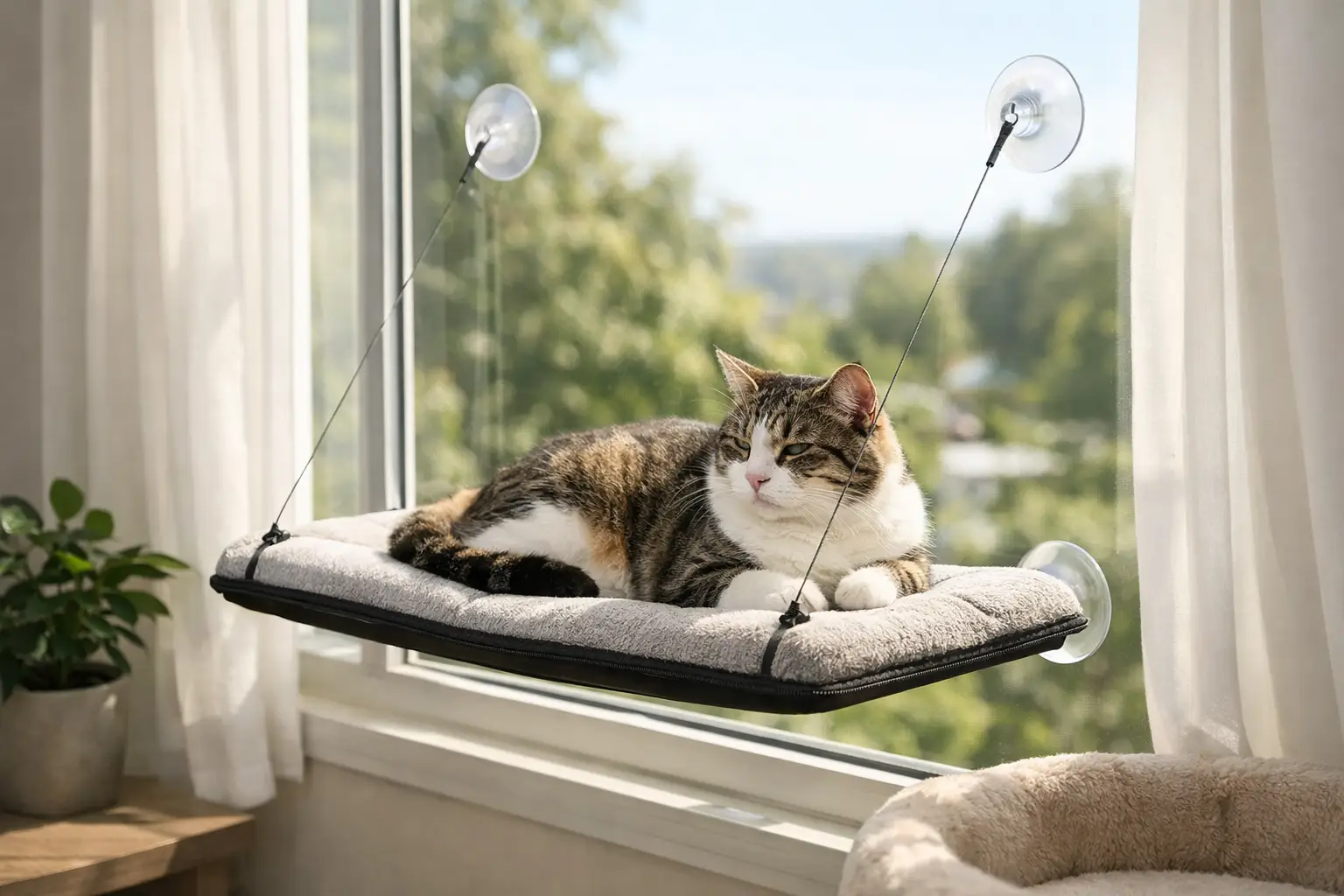
A great window spot can turn an ordinary afternoon into your cat’s favorite part of the day. The best cat window perch gives indoor cats a cozy place to nap, watch birds, track passing squirrels, and soak up a warm patch of sun without claiming the back of your sofa.
For pet parents, the right perch is a small home upgrade with a big payoff. It adds enrichment without taking up valuable floor space, and it can give a curious cat a better view than any cardboard box placed near the glass. Still, not every window perch is right for every cat. Weight, window style, attachment method, and your cat’s lounging habits all matter.
The best choice is not always the biggest, softest, or least expensive option. A perch should fit your cat comfortably and stay firmly in place through daily jumps, stretching, grooming, and nap-time repositioning. Start with your cat rather than the product photo.
A compact perch may be plenty for a kitten or petite adult cat who likes to curl into a ball. A larger cat needs a wider resting surface and a stated weight capacity that leaves room for a safety margin. If your cat weighs 15 pounds, choosing a perch rated for only 15 pounds is not the most reassuring option. Look for one designed to hold substantially more.
The window itself matters, too. Many popular styles use suction cups on smooth glass. These can be wonderfully space-saving, but only when installed on clean, dry, undamaged glass. Other designs rest on a window sill or attach to a wall nearby, which may be a better fit for windows with textured surfaces, narrow panes, or awkward frames.
Cats tend to choose warmth, security, and a clear view over fancy details. A soft removable pad is a welcome feature because it makes cleanup much easier. Fur, dust, and the occasional hairball happen, so a washable cover helps keep your cat’s favorite seat fresh.
Consider the perch shape as well. Hammock-style seats gently cradle cats and often appeal to cats that like to curl up. Flat platforms can be better for cats that stretch long, sleep on their side, or enjoy sitting upright to monitor outdoor activity. Some cats will love either option, but a senior cat or a cat with stiffness may prefer a firm, easy-to-step-onto platform over a deeper sling.
Window perches come in a few common styles, each with useful trade-offs. Choosing one gets simpler when you think about your cat’s mobility and the room where it will live.
These perches attach directly to the glass with heavy-duty suction cups, usually supported by cables or sturdy cords. They create a floating hammock look and leave the sill below clear. That makes them a smart pick for apartments, small rooms, and homes where every inch of floor space counts.
The key trade-off is maintenance. Suction cups need a clean surface and occasional checks. Temperature shifts, dust buildup, and loose cups can affect their grip over time. A well-made model with multiple large suction cups and a strong frame offers more confidence than a light, minimally supported design.
A sill perch rests on the ledge and may use brackets, clamps, or a stabilizing support beneath it. These often feel especially solid underfoot and can be easier for cats that do not love hopping onto a suspended hammock.
Before buying, measure the sill depth. A perch that overhangs too far or cannot sit level will not be as secure or comfortable. This style may also take up more of the usable window ledge, so it is worth considering if you keep plants or decor there.
If your windows are not suited to suction cups or sill brackets, a wall-mounted shelf near a sunny window can create the same happy viewing station. Freestanding cat trees with elevated platforms are another flexible option, especially for multi-cat homes.
These choices usually require more floor space or installation effort, but they can be a better long-term fit for larger cats and active climbers. They also work well when you want several cats to have their own designated resting spots.
A few quick measurements can prevent the most common window-perch disappointment: getting it home and finding that it does not fit where you imagined. Measure the window width, the glass area available for attachments, and the depth of the sill if you are considering a ledge-supported model.
Also look around the window. Is there a radiator directly below it? A floor vent? Long curtains that may tangle in the frame? Is the window frequently opened? A perch needs a calm, practical location where it can remain installed without interfering with everyday use.
For a cat who loves to launch from furniture, check the path to the perch. A nearby chair, cat tree, or low table can provide an easy step up. This is especially helpful for kittens, older cats, and pets recovering from minor mobility changes.
A cat window perch should feel like a dependable part of the room, not a gamble. Follow the manufacturer’s installation directions, respect the listed weight limit, and do a hands-on stability check before inviting your cat aboard.
For suction-mounted models, clean the glass with a residue-free cleaner and let it dry completely. Press each cup firmly into place, then test the frame gently with your hands. Do not yank it downward, but apply enough pressure to make sure the cups are holding evenly. Recheck the attachment regularly, particularly after deep cleaning the windows or during major temperature changes.
Keep cords, blind pulls, and dangling curtain ties out of reach. A window perch is meant for peaceful birdwatching, not a place for tangles. If the window opens, make sure screens are secure, but remember that a screen is not a reliable barrier for an excited cat. Open windows and unsupervised cats are not a safe combination.
Use this simple check before settling on a perch:
The sunniest window is often a winner, but a good cat view is about activity as much as sunlight. A window facing a yard, trees, a quiet sidewalk, or a bird feeder can offer gentle entertainment throughout the day. Even a modest view can become fascinating when leaves move, rain falls, or neighborhood life passes by.
Avoid placing the perch in intense direct sun all day during hot weather, especially if the glass gets very warm. Your cat should be able to move away from the heat easily. In colder months, check for chilly drafts around older windows. A soft pad can add comfort, but it will not solve a location that is uncomfortably cold.
In homes with more than one cat, window access can become surprisingly competitive. If your cats tend to crowd the same sunny spot, consider adding a second lounging area rather than expecting them to share one small perch peacefully. Giving each cat a choice can reduce squabbles and make the room feel more comfortable for everyone.
A window perch does not have to be complicated to make your cat’s routine more enjoyable. Choose a secure style that suits your window, give your cat enough room to settle in, and place it where the view changes through the day. Before long, that little seat by the glass may become the spot where your cat feels most content – and where you get to enjoy a few extra purrs, slow blinks, and peaceful naps.










Leave a comment